EQUINOR (EQNR)·Q4 2025 Earnings Summary
Equinor Cuts CapEx by $4B, Beats Revenue as Johan Sverdrup Enters Decline
February 4, 2026 · by Fintool AI Agent
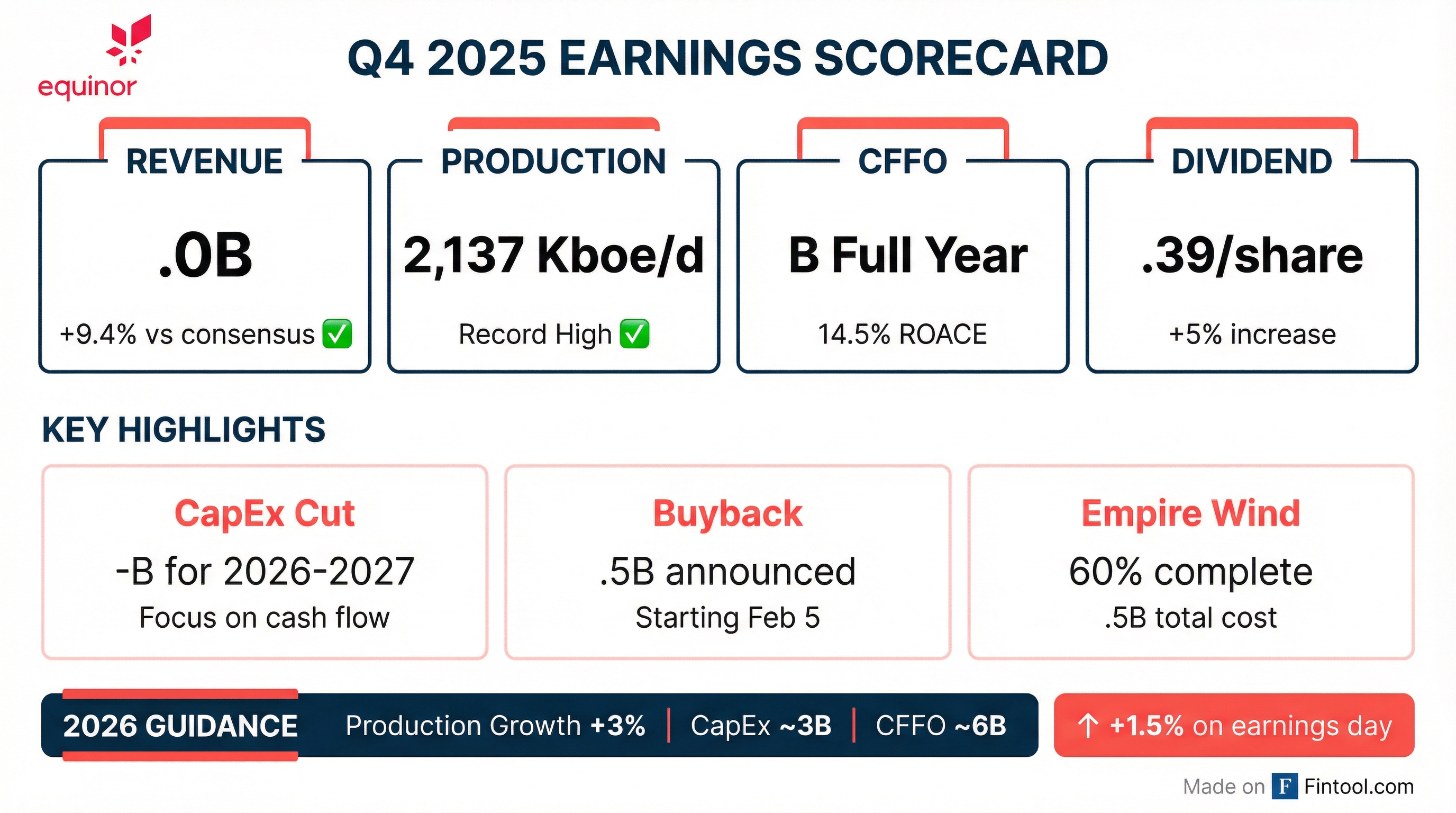
Equinor delivered a mixed Q4 2025, with revenue beating consensus by nearly 10% on record-high production, while earnings missed on impairments and lower commodity prices. The real story: management's aggressive pivot to cash preservation. CapEx is being cut by $4 billion over 2026-2027, primarily from renewables and low-carbon projects, as the company prepares for "lower prices and ensure that we can maintain a solid balance sheet through the cycles."
Did Equinor Beat Earnings?
Revenue: Beat. Q4 2025 revenue came in at $26.0 billion versus consensus of $23.8 billion, a 9.4% beat driven by record production and strong gas trading performance.*
EPS: Miss. Normalized EPS of $0.37 missed the $0.56 consensus by 34%. However, this was impacted by $626 million in net impairments and $282 million in losses on asset sales related to the Peregrino and Adura transactions. Management emphasized these were largely "technical" accounting treatments and do not impact adjusted numbers.
EBITDA: Miss. EBITDA of $8.6 billion came in 6% below the $9.1 billion consensus, reflecting lower commodity prices partially offset by strong MMP (marketing & trading) results.*
*Values retrieved from S&P Global
The revenue beat was amplified by an extraordinary gas trading quarter. CFO Torgrim Reitan highlighted that during January's winter storms, "the in-basin price for our Marcellus gas was $60 per MBtu... we achieved more than $100 per MBtu" in New York.
 Ask Fintool AI Agent
What Did Management Guide?
This is where the call got interesting. Management unveiled a significantly more defensive posture:
2026-2027 Guidance Summary
The CapEx Cut: Where's It Coming From?
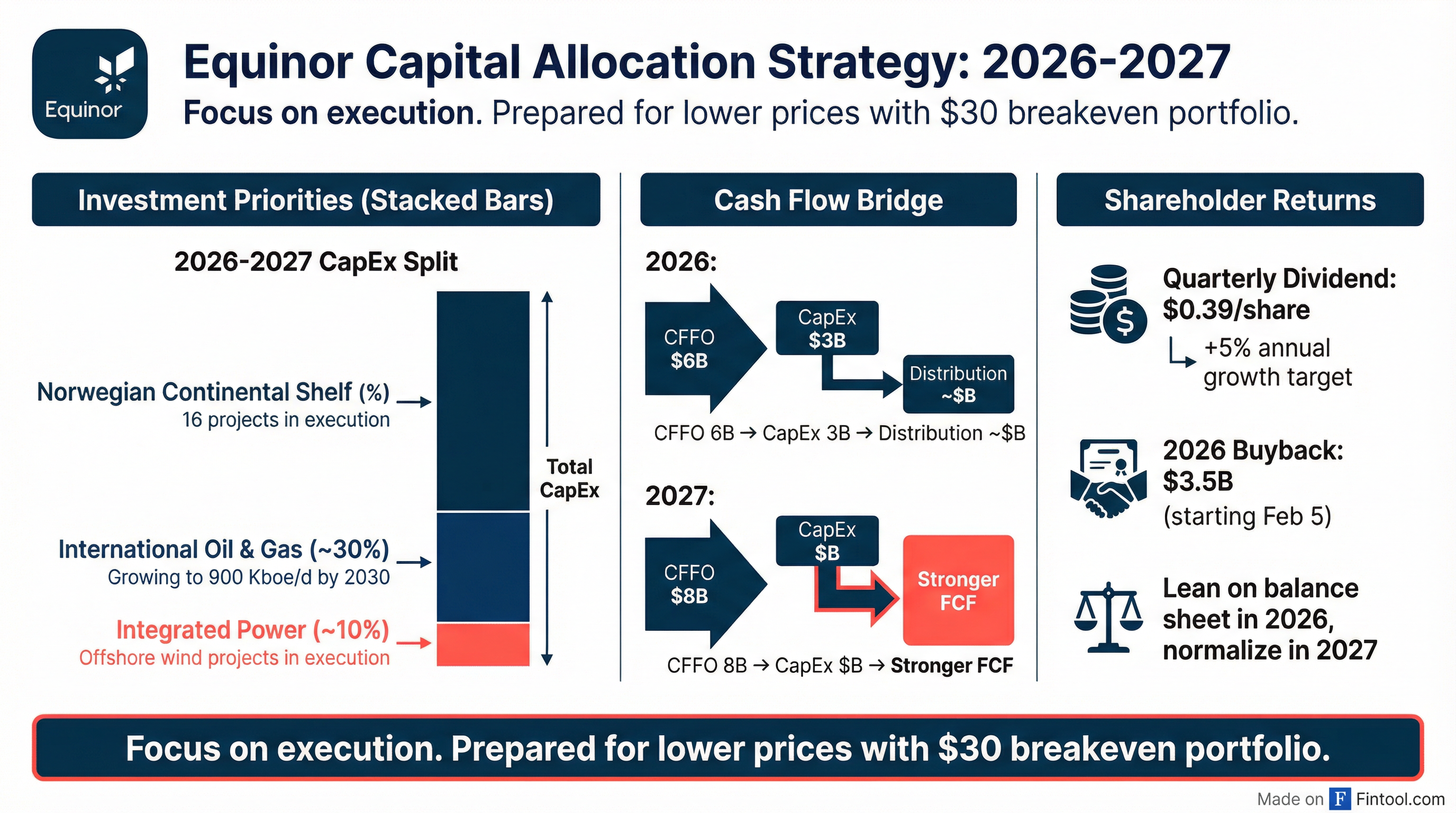
The $4 billion reduction comes almost entirely from renewables and low-carbon solutions:
- Hydrogen projects scrapped: Eemshaven hydrogen project stopped before FEED
- CCS markets slower than expected: "Customers continue to buy natural gas, but they have postponed their own targets for reducing emissions beyond 2030"
- Onshore renewables scaled back: Early-phase costs reduced significantly
- Empire Wind ITC: ~$2B tax credit monetization in 2027 helps offset remaining spend
Oil and gas investment remains stable at ~$10 billion annually — the cuts are entirely from the energy transition portfolio.
How Did the Stock React?
EQNR shares rose +1.5% on earnings day (February 4), closing at $26.34 versus $25.95 the prior day.* The muted reaction likely reflects:
- Revenue beat offset by EPS miss — headline confusion
- CapEx cuts were expected — street had anticipated a more defensive stance
- Johan Sverdrup decline was flagged — not a surprise to informed investors
- Buyback slightly below prior run-rate — $1.5B vs. the previous $1.2B "sustainable" baseline, but below the $2B some expected
*Values retrieved from S&P Global
The stock is trading near its 52-week range of $21.41 - $28.27, with the 50-day average at $23.81 and 200-day at $24.37.*
What Changed From Last Quarter?
Johan Sverdrup: The Elephant in the Room
CEO Anders Opedal confirmed the market's worst fear: Equinor's crown jewel is entering decline.
"A field like this, like all other fields, eventually it will come into decline, and we see that now. So we see a decline in Johan Sverdrup for 2026, which is more than 10%, but well below 20%."
Mitigating factors:
- Johan Sverdrup Phase 3 comes online late 2027
- Overall company production still growing 3% in 2026
- Team continues drilling new wells and optimizing recovery
Empire Wind: 60% Complete, Legal Battle Continues
Empire Wind 1 is now over 60% complete with all monopiles installed, offshore substation in place, and ~300km of subsea cables laid. Total CapEx now expected at ~$7.5 billion (up from prior estimates due to tariffs and the first stop-work order).
The project received a preliminary injunction in January allowing construction to resume after a December stop-work order. Management expects the remaining ~$3 billion of CapEx to be funded by ~$2.5 billion in investment tax credits and ~$600 million in cash flow from operations in 2027-2028.
CFO Reitan was blunt: "The threshold for stopping it is very high... going forward, it actually, pretty solid."
Adura: UK Portfolio Turns Cash Positive
The Shell JV (Adura) is now operational and expected to distribute more than $1 billion in dividends to Equinor for 2026-2027 combined, with growth from '26 to '27. This transforms the UK portfolio from cash-negative (due to Rosebank CapEx) to cash-positive.
Argentina Exit: $1.1B Proceeds
Equinor announced the sale of onshore Argentina assets for $1.1 billion, continuing its portfolio high-grading strategy. Proceeds expected in 2026.
Ask Fintool AI AgentKey Management Quotes
On the energy transition pivot:
"3-4 years ago, customers called us to buy natural gas and was also asking for potential hydrogen and transportation and storage of CO2. Today, they continue to buy natural gas, but they have postponed their own targets for reducing emissions beyond 2030."
On political risk:
"Energy investments are more and more politicized, and polarized. We see it in Norway, we see it in UK, we see it in US. And definitely for us, this brings some reflections about what is the above-ground risk you can take... with the political changes we have seen, which were kind of outweighed all the other factors that was reducing the risk, we would have probably have thought differently about Empire Wind in the past."
On cost discipline:
"We expect to reduce our unit production cost to $6 per barrel... We are the lowest cost supplier of piped gas to Europe, with our all-in cost of less than $2 per MBTU."
On NCS transformation:
"We will move time from discovery to production from 5-7 years to 2-3 years... We need 200-300 efficiency gains on the Norwegian Continental Shelf."
Q&A Highlights
On M&A Activity
Analyst asked about the international asset sales and future acquisitions. CEO Opedal: "We have been active both in divestment, where we think the timing is right to create value... when we have seen opportunistic opportunities to invest, we have done it, like twice, in the U.S. gas in the Marcellus. You can expect us to be active going forward."
On MMP (Trading) Volatility
The MMP segment delivered ~$1.25-1.3 billion in Q4 excluding a one-time gas contract price review win. CFO Reitan explained: "In January, our traders left 30% exposed to the prompt or the cash prices... at the most extreme, the in-basin price for our Marcellus gas was $60 per MBtu, and we took that."
On OpEx Reduction Claims
The 10% OpEx reduction target sounds impressive, but Reitan clarified it's largely structural: "It is a significant impact of the investment of Peregrino and the establishment of Adura that will be equity accounted. When you adjust for structural changes, we expect to maintain OpEx and SG&A flat."
On AI Investment
Management highlighted $130 million in savings from AI implementation in 2025, with acceleration expected: "We do believe that with our large operations and our ability to take out effect across assets, that AI can really be a significant contributor to further cost improvements."
What to Watch
-
Johan Sverdrup decline rate — Will it stay closer to 10% or drift toward 20%? Phase 3 timing in late 2027 is critical.
-
Empire Wind legal resolution — The merits of the case expected to be heard "within a couple of months"
-
US gas exposure — A $2/MMBtu move in US gas has similar cash flow impact as European gas ($800M), despite US being 1/3 the volume. Upside optionality in volatile weather.
-
Wisting and Bay du Nord FIDs — Both pre-FID projects progressing. Wisting concept decision expected in 2026, with potential DG3 in 2027. Bay du Nord approaching DG2.
-
Capital Markets Day (June 2026) — Management will present updated strategy toward 2030.
Historical Performance
*Values retrieved from S&P Global
Ask Fintool AI Agent